Counseling Services
Free, confidential support for all enrolled MCLA students.
Schedule an appointment
Students are seen at Counseling Services by appointment only. Email or call 413-662-5331 between 8:30 a.m. and 4:30 p.m., Monday through Friday, to schedule an appointment.
counselingservices@mcla.edu
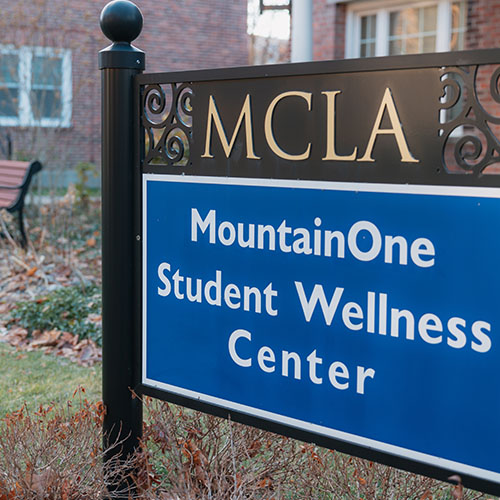
MountainOne Student Wellness Center, 2nd Floor
8:30 a.m. to 4:30 p.m., Monday through Friday
after Hours & Emergencies
After 4:30 p.m. and on weekends, please call the Crisis Team of the Brien Center for Mental Health & Substance Abuse Services at 1-413-499-0412 or 1-800-252-0227, or go to the North Adams Campus of BMC Emergency Room.
If you live on-campus, you may also contact the MCLA Department of Public Safety at ext. 5100, a Resident Director, or a Resident Assistant.
Counseling Services
Counseling Services is committed to helping students achieve their personal and academic success by assisting them to resolve personal difficulties and by serving as mental health consultants to the entire campus community.
There is no cost to students for using Counseling Services. However, if you are referred to an outside provider you will need to use your health insurance to cover the cost of those services.
Counseling Resources
Suicide Prevention Hotline: 1-800-273-TALK (8255)
Samaritan Helpline: 1-877-870-HOPE (4673)
Text a Crisis Counselor: 741741
General College Student Mental Health Resources
- Active Minds, Student Mental Health Advocacy and Education
- Mindful Eating, Strategies for healthy eating
- Apps for Mental Health
Emotional Health and Suicide Prevention Resources
- The Jed Foundation, The nation's leading organization working to promote emotional health and prevent suicide among college students.
- Half of Us, MTV's mental health campaign to address depression and combat suicide among American youth
- How to Support Someone You Know Who is Suicidal
- MCLA CARE Team Info Sheet
- Recognizing Warning Signs in College Students
- Supporting Grieving Students
- Tips for Talking About Suicide
Race-Based Traumatic Stress and Psychological Injury
MCLA Counseling Services is committed to providing quality services to enrolled students. As college mental health professionals, we recognize that for many students, personal, developmental, or psychological challenges may arise during their time at MCLA, and may jeopardize their ability to fully benefit from their educational experience. Our staff aims to help and support students as they struggle with these challenges.
We know that for most students, parents continue to play an important role in their lives. While the college years typically present significant changes in the relationship between parent and child, research (as well as our own experience) suggests that those students who maintain positive and trusting relationships with their parents experience fewer struggles in the areas of college adjustment and self-esteem, and tend to make better behavioral choices while at school.
We believe that the college years ideally encourage increased independence and autonomy for students, however we also recognize and respect the ongoing role you will play in the upbringing and welfare of your child. To this end, we offer the following information in the spirit of hoping that you will assist us in our efforts to be of service to your student.
Recognizing the Signs of a Potential Problem: As a parent, you may have access to "information" that may be relevant to your student's psychological well-being. The following verbal and behavioral signs may be suggestive of a potential problem:
- Aggressive or threatening behavior
- Social withdrawal, or other marked change in social habits
- Marked changes in personal hygiene
- Preoccupation with weight, food, or exercise
- Dramatic weight loss or gain
- Excessive crying or mood changes
- Marked changes in energy level (e.g., listlessness or hyperactivity)
- Noticeable changes potentially associated with drinking or drug use
- Increases in pessimism, hopelessness, or helplessness
- Change in academic habits (e.g., a historically hard-working student who seems not to care about academic performance anymore)
- Bizarre behaviors (e.g., paranoia, strange speech patterns)
- References to suicide or death
- Any other behaviors or symptoms which represent a distinct departure from the behavior you've always seen from your child
Some general guidelines for how to respond to your concerns:
- Don't "put off until tomorrow." Bring up issues and concerns with your student as soon as you begin to notice problems. Ignoring disturbing behavior is unlikely to "make it go away."
- Have a caring, concerned, nonjudgmental discussion in private, at a time and place that is conducive to a meaningful conversation.
- Listen to your student at least as much as you talk to them.
- Avoid the tendency to be critical or judgmental.
- Avoid the temptation to offer easy solutions to problems, or to "take care of everything" for your student; rather, problem-solve with them regarding specific actions they may take to confront their issue(s).
- Know your own limits. Parents are an incredibly powerful part of a student's life, but sometimes deferring to professional help is appropriate and called for.
Making a Referral for Counseling Services: In many cases, your student may be hesitant regarding seeking professional help. They may need to know that you don't see them as a "failure" or as "weak" for doing so. If, indeed, you have decided to recommend to your student that they seek our services (or other professional mental health services), be prepared to give specific information regarding cost (free), location (MountainOne Student Wellness Center, 2nd Floor), and how to make an appointment (by calling 413-662-5331). You might suggest that your student "give counseling a try" by attending one session. Finally, be realistic; sometimes a seed or two needs to be planted before a student "hears" others' concerns and actually follows through with a counseling referral. If, however, there is clear and imminent danger to your student or somebody else, respond more aggressively by contacting your local hospital emergency room, your local police, or MCLA Department of Public Safety at ext. 5100.
Understanding Confidentiality: You and your student should understand that as required by state and federal law,
as well as professional ethical codes, mental health professionals are obligated to
protect the privacy and confidentiality of their clients and their disclosures. There
are exceptions to confidentiality (outlined more extensively on the Confidentiality
Page of our website), which typically involve imminent danger to self or others, but
in general, students expect (and we honor) protection of their confidences. These
confidentiality requirements remain in effect even when a parent has made the referral
for their student to counseling services. Please understand that while we will respect
our students' confidences, and comply with the law, we will certainly listen to concerns
about a student from interested parties, including, of course, parents.
Counseling Services Team
MSW, LICSW
Ashleigh Hala is MCLA's associate dean and chief wellness officer, providing leadership for Counseling Services, Student Health Services, Health Promotion, Prevention, Peer Education, and the Care Team. Before joining MCLA, she led wellness and prevention initiatives at Wake Forest University and Babson College, where she also served as the founding director of Sexual Assault Prevention and Response Services.
Ashleigh holds bachelor's and master's degrees in social work and is a licensed independent
clinical social worker. She is actively involved in national higher education and
college health organizations, serves in leadership roles with NASPA, and frequently
presents on wellness, prevention, and student support. She is passionate about creating
a campus culture where every student feels supported and has the opportunity to thrive.
LICSW
Claire is a licensed independent clinical social worker (LICSW) and staff counselor at the MCLA Counseling Center, where she has worked for many years. In addition to her role at MCLA, Claire has worked at The Brien Center in Great Barrington, the Bennington, Vermont, school system, and currently serves part time at Greylock Mental Health.
Claire enjoys working with students who are pursuing a specific path as well as those
who are exploring their goals and future direction. She has worked with people from
a wide range of backgrounds and values creating a supportive space where students
can share their stories, reflect on their experiences, and explore how those experiences
shape their lives at MCLA and beyond.
LICSW
With over 25 years of experience supporting the well-being of youth and young adults across the Berkshires, Amrita utilizes a strengths-based empowerment model, empathy, and a trauma-informed approach. She incorporates mindfulness, somatic practices, expressive arts, and essential integration into sessions depending on what each student needs. She is extensively trained in various modalities and offers EMDR, TF-CBT, CPT, DBT, and IFS-IFIO. Whether working with individuals, couples, or groups, Amrita supports students to remember themselves, their innate qualities, and inherent wisdom. All are welcome.
Susannah has served as a medical assistant at MCLA Student Health Services since 2018.
Before joining MCLA, she spent 26 years working in a hospital, where she held a variety
of roles, including transcription and medical coding. Currently, Susannah provides
primary administrative support for the College's wellness departments, including Student
Health Services, Counseling Services, and Health Promotion.
FAQs
Absolutely. We can assist you to identify if there is a problem, to decide what you should do, if anything, and provide you with support.
Connect with us

@mclawellness

@mclawellness